


Kyrgyzstan is not for everyone, luckily
- Brett
- Jul 27, 2018
- 10 min read

Updated: Jul 29, 2018
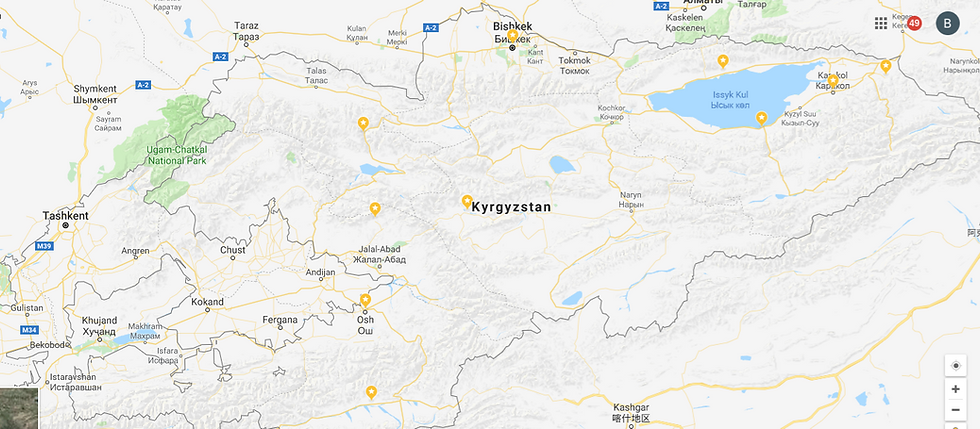
If you look at a map (and know where you should be looking) Kyrgyzstan appears as a fairly small country. Compared with its neighbors, China, Kazakhstan, and Uzbekistan, it is small. It’s about the same size as the American state of Washington. In spite of it’s relative size, I spent five weeks in Kyrgyzstan and could easily have stayed longer. I found it to be a delightful place to lose track of the rest of the world, in the summer anyway. The capital, Bishkek, has some western comforts that you won’t find in the rest of the country, things like coffee shops, wine bars, and bacon. Issy-Kul is a huge lake ringed by snowcapped mountains with beaches some of which are serene, others crawling with sunburned Russians blasting local pop music, drinking vodka, and inhaling watermelon. Osh, the second largest city in the south of the country is fairly traditional and has some impressive tile murals, a giant bazaar, and pleasant tree lined streets. And then there are the mountains. According to one statistic I read, 70% of the country is mountains. And they are stunning.
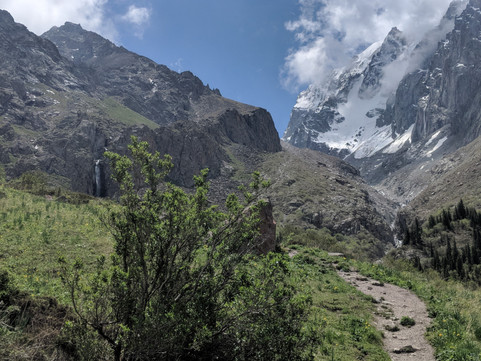
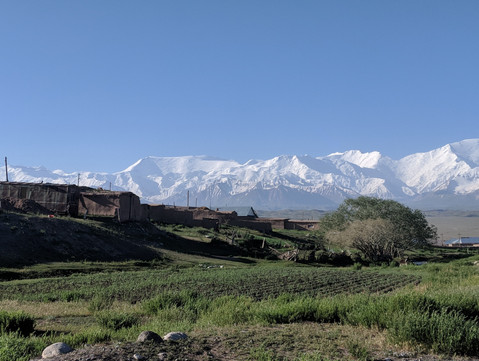
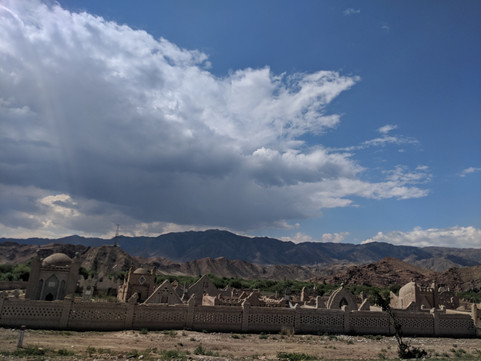
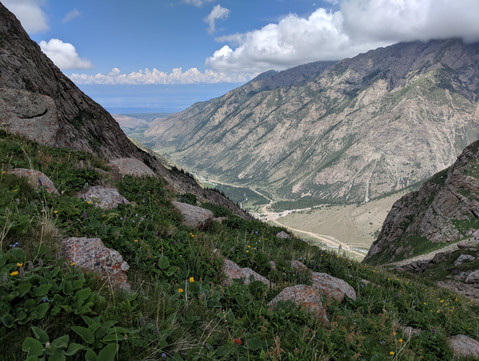
These mountains can be quite different depending on where in the country you are. The photos below show the variety between mountains in the Ala-Archa national park near Bishkek, the majestic Pamir range in the far South near the border with Tajikistan, more arid mountains center of the country, and the Tian Shan range surrounding Lake Issy-Kul.


Before arriving in Kyrgyzstan I was nervous. Even though this was part of the country's appeal for me, it sounded like a rugged place with little infrastructure for visitors and figuring out how to get around in a place where few people spoke English and everything was written in Cyrillic sounded daunting. While it was disorienting at first and certainly not as convenient as SE Asia, it was easier to get from place to place than I feared. Like any destination, there are organized tours you can join but I began bu talking to other fellow travelers. These travelers on the whole seemed more mature and my kind of people than the average visitor to SE Asia and were primarily European and Israeli though I met a handful of North Americans too. More unique to Kyrgyzstan though is the network of Mashrutkas (minibuses) that ply the often terrifying local roads. They can be crowded, terrifying, and uncomfortable (climate control consists of ceiling vents and a fellow passenger puked all over the floor on my ride from Bishkek into Kazakhstan) but for getting you from point A to point B they are an absolute bargain. One day I spent 8 hours in four different Mashrutkas and spent less than $10. Once you figure out exactly which Mashrutka you need and where to catch it, which may involve miming with a local and politely telling a taxi driver to bugger off, the system works surprisingly well.
The other unique resource that simplifies traveling in Kyrgyzstan is the Community Based Tourism (CBT) offices located in major towns and tourist centers. There were several instances where the local CBT office was the first place I would go when I arrived at a new destination. At each office I encountered staff speaking good English. They could arrange a guesthouse for me and direct me to the places I should consider visiting. In Sary Moghul, a village in far south near Tajikistan, the office set me up with two nights in a yurt camp in the Pamir range, a car doing trailhead drop off and pick up, and a tiny pony to ford a river that in hindsight I probably could have waded across. But, I was able to check off the “I rode a horse” box that is a requirement to get an exit stamp at the Kyrgyz border! Had I wanted it, the CBT could have arranged a guide for me as well and rented me a 3 kg (6 lb) tent or sleeping bag. As a bonus, I felt good knowing that the money I spent at the CBT stayed in the community as opposed to, say, a company in Bishkek.
In the town of Kazerman, an area that sees very few tourists because it is hard to get to, the CBT coordinator, also an English teacher at the local high school, helped me figure out how to get shared taxis in and out of the city at a decent price. I spent the night at her guesthouse and enjoyed talking to both her and her daughter, a university student eager to practice English with a native speaker.
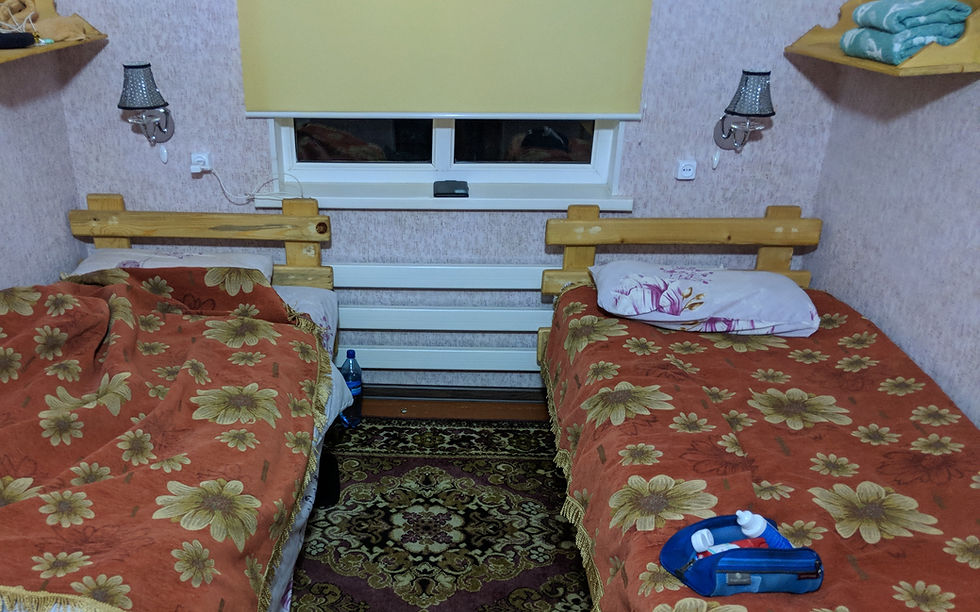
With the exception of the larger cities and the resorts along Lake Issy-Kul accommodations in Kyrgyzstan consist of guesthouses and yurt stays. The guesthouses are basic affairs, in one I slept on the floor on traditional cushions. Not all had WiFi and at most I had to walk outdoors to get to the toilet and shower. They always included a breakfast with eggs and a lavish spread of home made jams and usually offered a traditional Kyrgyz food for dinner for about $3. Guest house prices seemed fixed in each village I visited and I think the most I paid was $10 a night.
I suppose this is a good time to talk about the food in Kyrgyzstan, which, other than the fresh produce, bread, and guesthouse breakfasts I found to be disappointing. This was partly because I had come from SE Asia though. The cuisine is fairly bland and centered around meat (which to it’s credit is very fresh though sometimes horse), potatoes, onions, and bread. The most common dish is plov, a rice and meat pilaf, sometimes with raisins, carrots, and chickpeas, found throughout Central Asia. There are a few Chinese influences to the cuisine with dishes like manti, a meat filled dumpling, and lagman, a noodle dish with sauteed vegetables and meat (which a woman from Korea pointed out to me sounds a lot like lo mein). There are also middle eastern influences in the form of shashlik (which we would call shish kebabs) and samsas, bread dumplings filled with either meat and onions or potatoes and onions.
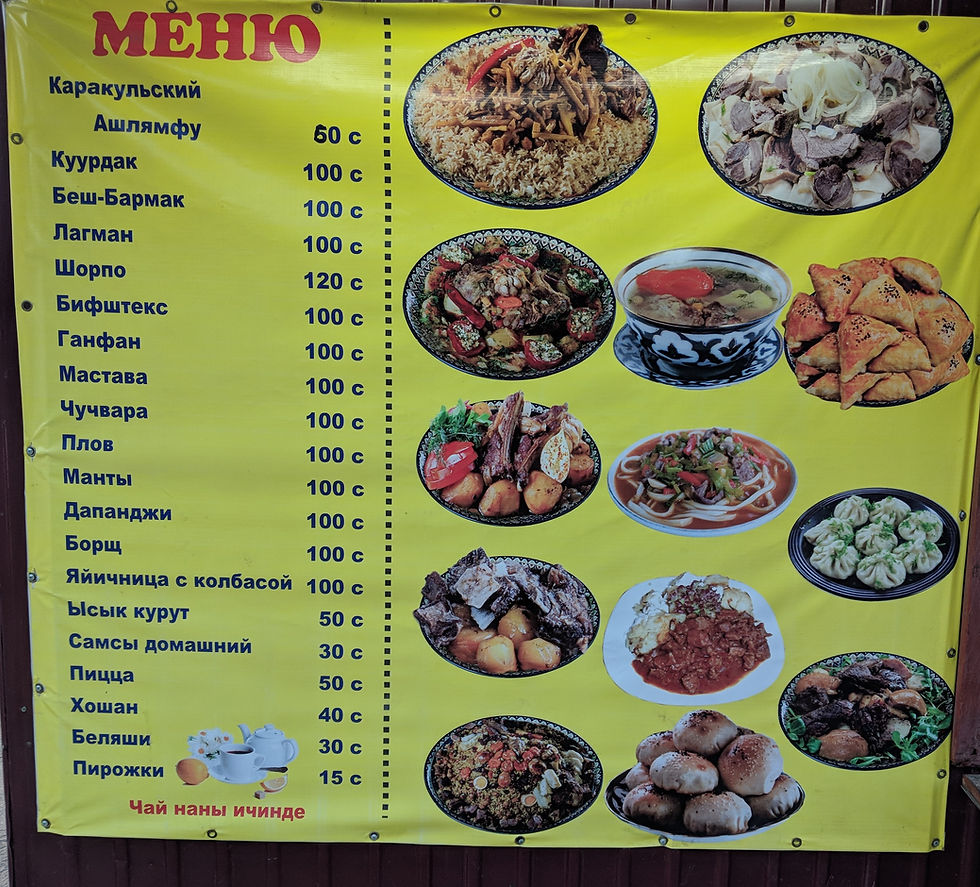
This time of year there are lots of fresh fruits and vegetables in the bazaars particularly tomatoes, cucumbers, eggplants, peaches, apricots, melons, and my personal favorite, cherries. I heard that in winter outside of Bishkek fresh produce is limited to cabbage, potatoes, and sad looking apples. I met a fair number of vegetarian or vegan travelers and pretty much all of them were cooking for themselves, making dietary sacrifices, or causing great confusion with requests for meat free food at guesthouses without access to a kitchen. Though Kyrgyzstan is majority Muslim, in most parts of the country they are Muslims with a fondness for alcohol. The national drink is fermented mare’s milk and in a normal sized supermarket I’d say about ¼ of the shelf space is devoted to beer, local brandy, and vodka. Alcoholism is a serious problem in the country.
On the whole, I found people in Kyrgyzstan to be very friendly and eager to talk to me, particularly when they found out I was from the United States. They don’t see a lot of American visitors and always wanted to know more about the mysterious land they see in movies and TV. I had some great conversations with the locals I met who spoke English. Based on what I heard, even relatively affluent Kyrgyz people live very different lives from me and I was struck by how isolated the country is from the rest of the world. The English teacher from Kazarman, who had been teaching for at least 15 years, earned roughly $170 per month, almost enough to rent an apartment in Bishkek. Her home was very comfortable and had most Western conveniences but I got the sense this was because her husband is an engineer at a nearby gold mine. What struck me was that despite the fact that she was an English teacher she had never left Kyrgyzstan, in part because that $170 per month won’t get you much when you leave the country.
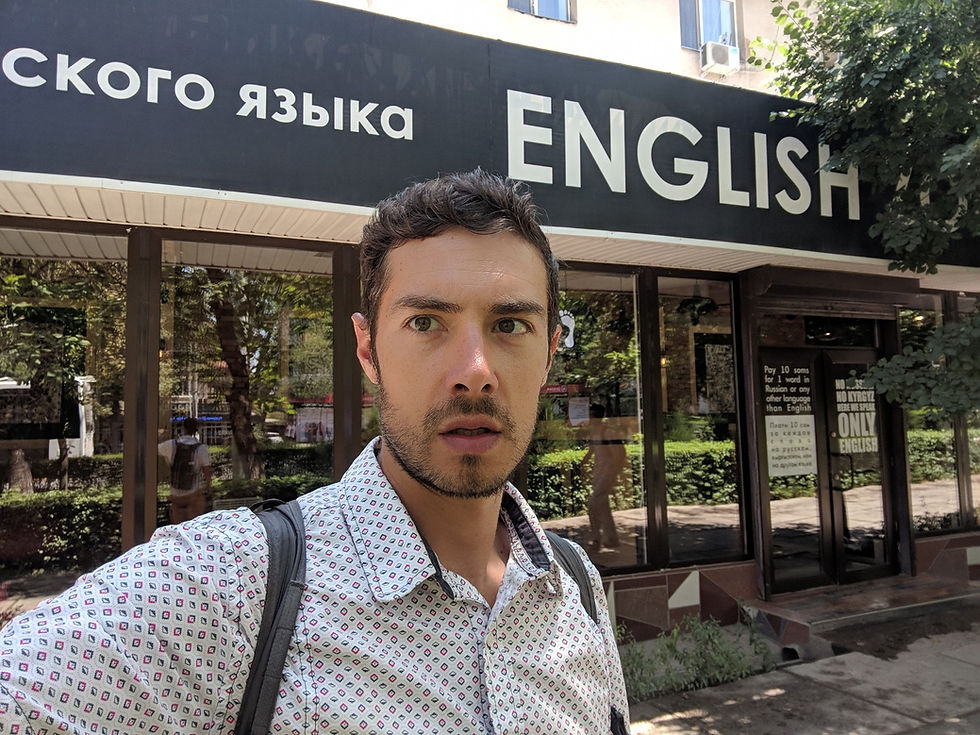
I had a chance to talk to a number of younger Kyrgyz folks who were teachers and staff at the English Zone, an English teaching school in Osh. They were all in or had recently been in University, most grew up in Bishkek, were fluent in YouTube, and aware about American pop music and current events. Only one had been outside Kyrgyzstan. She had recently returned from a year in Lewiston, Idaho on a university exchange program and was having a hard time adjusting back to life in Osh. Osh is very traditional and she felt like her near future there, if she stayed, would involve finding a husband and having a few children which she was not yet ready for. All of the English Zoners wanted to travel, and peppered me with questions about visiting United States. I told them I thought they would need about $1,500 for a week long trip in New York City, assuming they would stay in a non-fleabag hotel, eat out, and go shopping. They looked at me like I was nuts.
We also talked quite a bit about American attitudes towards premarital sex, or rather my American attitude on the topic. It turns out this is a bit different from prevailing Kyrgy norms especially outside Bishkek. Each of the Ezoners wanted a memento from the US and I had to get a little creative digging through my bag since most of what I carry are things I don't want to part with. I scrounged up some leftover international currency, a crumpled but still legible issue of The Atlantic, a pack of Starbucks Via, and a few Trojans. These were by far the most popular because they are noticeably larger than the local brand Relax. Or at least the package is bigger...
Early on in my time in Kyrgyzstan, Aigul, the owner of the Apple Hostel, told me it actually is common for Kyrgyz people to leave the country, however most who do so are working in Russia or Kazakhstan and sending money to family members back home. These overseas remittances are the biggest contributor to the country’s economy. Almaty is the biggest city in neighboring Kazakhstan and is a four hour puke-filled Mashrutka ride from Bishkek. I spent a few days there after Kyrgyzstan and was struck by how affluent it seemed. At least a sizable chunk of the population enjoys a lifestyle similar to that of a middle class European or American, in large part thanks to oil money. Leaving Almaty, I took an Uber to the airport and the man that picked me up drove a Mazda hatchback with the steering wheel on the wrong side of the car, which is very common in Kyrgyzstan but not in Kazakhstan. The Mazda had Kyrgyz plates and my driver, weaving through traffic and speeding frantically as if I was late for my flight (I wasn’t at all), seemed pretty Kyrgyz to me. My guess is that he is one of Kyrgyzstan’s many migrants. Within the country’s borders there is a gold mine run by a Canadian company that makes up 13% of the GDP.
Wendy, a friend of my aunt who works at the Peace Corp office in Bishkek confirmed for me that outside of Bishkek, Kyrgyz life is highly traditional. I had realized this when I walked past horses and sheep to go to the toilet in guesthouses where no one spoke English. She said that there are certain villages and regions where most people speak only Kyrgyz; they don’t speak Russian either, which is the language preferred by most government officials and businesspeople. Macho culture from nomadic days is alive and well and sexual assault is significant problem for local Peace Corps volunteers, particularly when riding Mashrutkas. Interestingly, I met several woman solo travelers and the topic of lecherous men never came up in our conversations, but I think it's a good idea to be cautious in Kyrgyzstan as you would anywhere else in the world if you are a female traveler.
Politically, the country is a den of intrigue with many Russian tentacles. From what I have read it is the most democratic of the Stans. Unlike in neighboring countries there have been two successful revolutions in response to governments that were inept and kleptocratic. Still, it seems like corruption, infighting, and political favoritism are alive and well, after all Russians essentially created Bishkek. Wendy told me that American influence has been on the decline since the US Air Force pulled out of the Manas Air Base that was used to stage the bombing campaign in Afghanistan. Since the base, which is next to the Bishkek Airport, closed in 2014 the Peace Corps office has had to figure out how to most effectively work with the local government now that the United States has a much smaller footprint and influence in Kyrgyzstan. The Trump administration has yet to appoint an Ambassador to Kyrgyzstan though apparently one is coming soon. China has a border with Kyrgyzstan and is behind a few much needed road projects in the country but otherwise is much less influential than in SE Asia. You won’t find hordes of Chinese tourists in Kyrgyzstan. Though you will find Russians on the north shore of Lake Issy-Kul.
Now you have more info on traveling and my impressions on life in Kyrgyzstan than is probably useful for you. I found it to be an absolutely beautiful place with some generous people that was surprisingly easy to get around. I did have to get comfortable being uncomfortable, both physically in the back of a mashrutka or sleeping on a guesthouse floor, and mentally when confronted with Cyrillic everywhere and a way of life that is noticeably different from mine back home. There are package tours in the country that I am sure would help ease some of this discomfort (Apple Hostel would be happy to arrange one for you!) but probably won’t do the job entirely. In my opinion this discomfort is part of Kyrgyzstan's charm.
The best way to sum up my impressions of visiting Kyrgyzstan is to steal a phrase from a piece of promotional material for my alma mater Whitman College circa 2001. Kyrgyzstan is not for everyone, luckily. Back then this phrase appealed to my rugged and more elitist tendencies, some of the same ones that attracted me to Central Asia. If you are in search of the party of a lifetime, a worry free getaway, or require creature comforts like air conditioning, a private bathroom, and predictable WiFi everywhere you travel, look elsewhere. If you still want to explore Central Asia’s stunning mountains and nomadic lifestyle perhaps Southern Kazahkstan will be more your speed. But, if you don’t mind roughing it, are willing to take some time to decipher Cyrillic (or are willing to just take whatever comes your way), enjoy mountain adventures and jaw dropping landscapes, don’t mind putting your life at greater risk than is reasonable and prudent when you get into a moving vehicle, and want to go somewhere that for the moment is mostly untouched by mass tourism you’ll probably have a fantastic time in Kyrgyzstan. If you do, just don't tell anyone. Oh, whoops.


Comments